Projects & Career Preparation
Full Stack Projects That Strengthen a Fresher's Resume
By Hejex Technology Published Practical guide for students and freshers
A useful development project is not simply an app that runs. It should help you demonstrate what you built, how its parts work, how you tested it, and which decisions you made. This guide explains what to include in a fresher's Full Stack portfolio, with a real React-and-AI student project as an example.
What Makes a Full Stack Project Valuable on a Fresher's Resume?
Recruiters and interviewers can learn more from an application you can explain than from a long list of frameworks. For a beginner, the strongest evidence is usually functional depth, clear ownership and understandable documentation. A simple project built thoughtfully can communicate more than an elaborate demo copied from a tutorial.
A real user problem
Explain who the app is for, what task it helps complete and what a successful result looks like.
A working technical flow
Show the user interface, API requests, loading and error handling, plus back-end and storage when present.
Decisions you can defend
Describe why you chose a framework or design, which bugs you encountered and what you changed.
Proof someone can inspect
Provide a live demo if available, repository or code samples you own, screenshots and a useful README.
Try not to list every feature as "AI-powered" or "production ready" without explaining what the feature actually does. The application should speak through a demonstrable workflow.
Five Full Stack Project Ideas That Help Freshers Demonstrate Skills
These are project suggestions, not claims that every example below was built by Hejex students. Choose a scope you can complete, test and explain. You can start with a small version and add features gradually.
| Project idea | Core workflow | Skills to demonstrate |
|---|---|---|
| Movie booking application | Browse shows, select seats and review bookings. | React UI, API calls; add booking API, validation and database for a complete full-stack version. |
| Expense tracker | Add transactions, categorize spending and view summaries. | CRUD APIs, database queries, form validation, data visualization and authentication. |
| Appointment booking system | Show available slots and create or cancel reservations. | Availability rules, conflict prevention, server-side validation and persistence. |
| Job application tracker | Save opportunities, interview stages and follow-up dates. | Authentication, search/filter, relational data and responsive UI. |
| Learning dashboard | Track lessons, quizzes and progress. | Role-based access, APIs, progress data and accessibility. |
For a first portfolio, an expense tracker or booking system can offer enough real-world complexity without requiring a large team. Pick functionality that you can finish and maintain; avoid adding payment processing or personal-data collection unless you can implement the necessary safeguards.
How many projects should a fresher show?
There is no universal minimum. One strong, independently explainable project plus a smaller complementary project is often a more useful starting point than several nearly identical tutorials. Add a third when it offers new evidence, such as a different back-end stack or a more challenging data model.
Student Project Example: BookMySeat With React JS, APIs and Generative AI
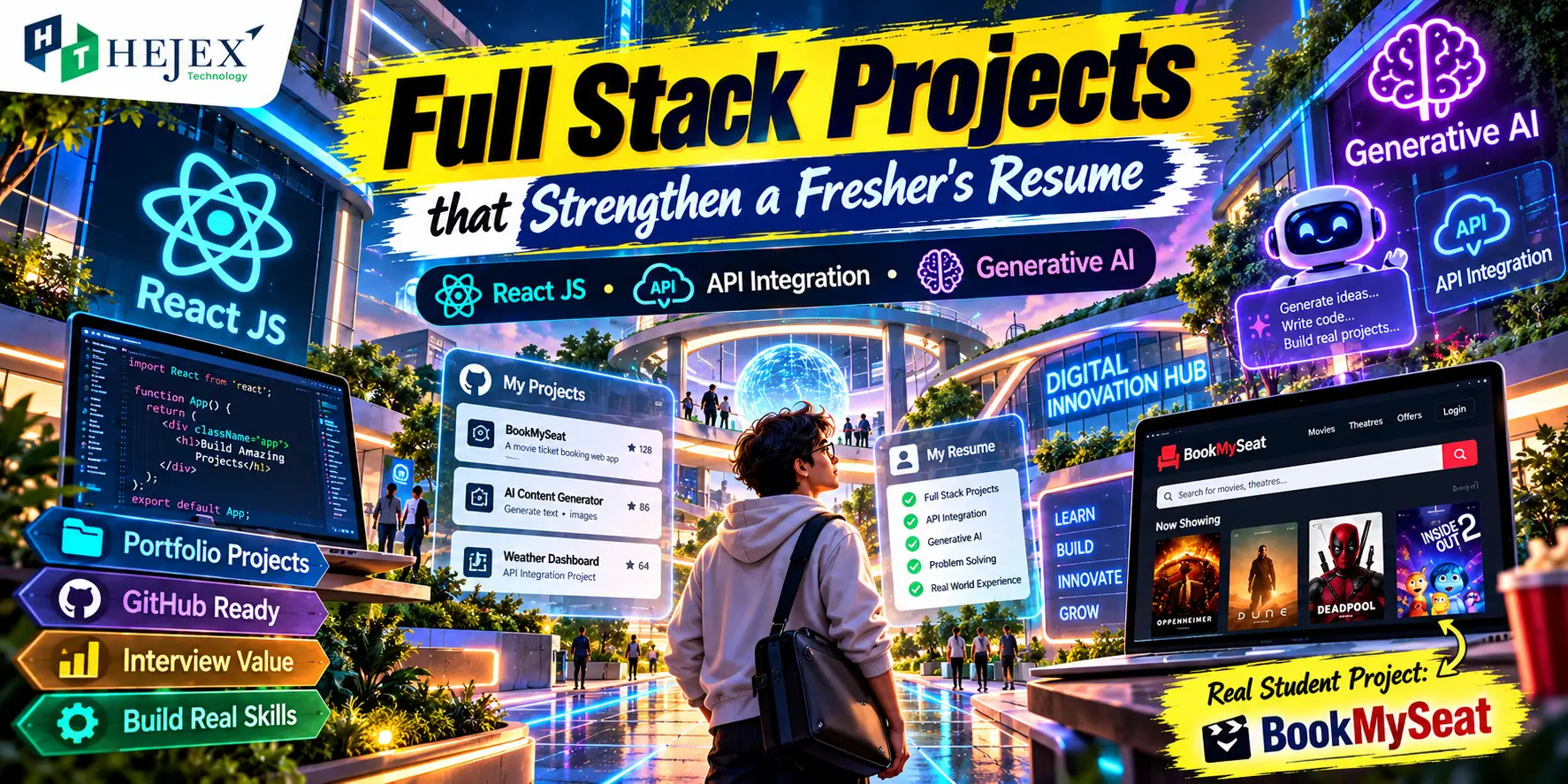
BookMySeat is a movie-booking application presented by Hejex Technology as a student development project. Its described interface supports movie and theatre browsing, showtime and seat selection, and booking-related interactions. The project uses React JS, API integration and Generative AI for chatbot conversations or message refinement.
Featured Hejex student project
BookMySeat — Movie Booking Experience
What students can demonstrate
- Breaking a movie-booking interface into React components.
- Handling user actions and state as a booking moves through steps.
- Connecting parts of an application with APIs.
- Designing chatbot prompts and refining generated messages.
Questions worth answering in a portfolio
- Where does movie or booking data come from?
- What happens if a request fails or returns no data?
- How are seats, selections and chatbot messages handled?
- Which parts did the student personally implement?
How is Generative AI used in BookMySeat?
According to the project's described scope, a chatbot assists with snack or combo ordering conversations and with refining its messages. That is an example of AI-assisted interaction inside a web application. It is not the same as training an AI model or fine-tuning model weights. A good case study should make clear what the model receives, what it returns, how the application handles unexpected replies and when a conventional form might be more reliable.
If publishing screenshots or source code, protect any API keys, authentication tokens, student details and paid-service credentials. A real project example is stronger when it is specific and responsibly documented.
What Turns a React Project Into a Full Stack Project?
A React interface can be an excellent portfolio piece. To accurately present it as a full stack web application, show how a user action reaches a server and, when the feature requires it, how data is stored and retrieved.
React interface and forms
Requests and response handling
Business rules and validation
Database where needed
For example, a possible extension to a booking app would send a seat reservation request to a server, check whether the seat is available, store the reservation, and return a confirmed result or an error. This is a suggested learning extension, not a claim that BookMySeat currently implements that exact architecture.
What should you build first?
- Start with the interface: define the user journey and build responsive pages with clear forms and states.
- Connect an API: use predictable requests, loading indicators, retry options and helpful errors.
- Add server-side rules: validate inputs and enforce permissions on the server, not only in React.
- Persist necessary data: design a small database schema and test create, read, update and delete flows.
- Test and deploy: verify common success, empty, invalid and failure conditions on mobile and desktop.
- Document the result: explain architecture, trade-offs and the work you personally completed.
For foundational practice, see the React JS tutorial, and for the basics of network requests consult MDN's Fetch API guide.
How to Present a Full Stack Project on GitHub and Your Resume
Your repository and resume should let someone understand the project without guessing. Write for both a technical interviewer and a person who has only a minute to skim.
A useful README checklist
- Project purpose and target user
- Features that actually work
- Technologies and what each is used for
- Local setup and environment-variable names
- Architecture or a simple flow diagram
- Screenshots and safe demo link
- Known limitations and future improvements
- Your contribution and testing notes
A README belongs with the repository and should explain how the project works. GitHub's own README documentation is a useful reference.
Example: How to describe BookMySeat on a fresher's resume
BookMySeat — React JS Movie Booking Project
- Built interactive movie-browsing and seat-selection screens using React JS.
- Integrated APIs and developed AI-assisted chatbot interactions for booking-related conversations and message refinement.
- Developed and documented application flows, user interactions and limitations for demonstration.
Illustrative resume wording: use a bullet only if you personally implemented the described feature. Replace "developed" with "contributed to" when working on a team; never invent performance improvements, user counts or employer endorsements.
What might an interviewer ask?
- Walk me through a user action from the UI to the response.
- How did you handle loading, failed APIs and unexpected responses?
- What would you change if two users selected the same seat at once?
- Which component or feature was hardest to implement, and why?
- How is your AI chatbot constrained, evaluated and kept from exposing secrets?
If you can answer those questions with code and a working example, the project gives the interviewer useful evidence of your understanding.
Which Technology Stack Should Freshers Use for Projects?
The best first stack is usually one you can learn and explain consistently. A React interface may work with a Java/Spring Boot, Python/Django or Node.js back end. Your decision should be based on the project requirements, existing skills, and how much complexity you can test—not a claim that one language guarantees a job.
For a practical comparison of back-end learning paths, read Java vs Python vs MEAN Stack for Freshers. This is complementary to the present article: that guide helps you choose a stack, while this guide helps you prove what you can build.
If you want an instructor-guided learning path with practical assignments, explore the Full Stack Developer Course in Chennai at Hejex Technology, including its currently published tracks, syllabus and project expectations. Compare the curriculum against your own goals before enrolling.
Frequently Asked Questions About Full Stack Projects for Freshers
From Project Ideas to a Working Portfolio
A strong learning plan turns fundamentals into projects you can build, debug and explain. Review the training tracks, projects and practical curriculum offered by Hejex Technology in Chennai to decide whether guided Full Stack development training fits your goals.
Explore the Full Stack Course in ChennaiEditorial note: The project ideas and interview examples are educational guidance. BookMySeat is presented as a student-project example based on the technologies and features described by Hejex Technology. The availability and functionality of external demos can change. Hiring outcomes depend on many factors; no project guarantees a job.