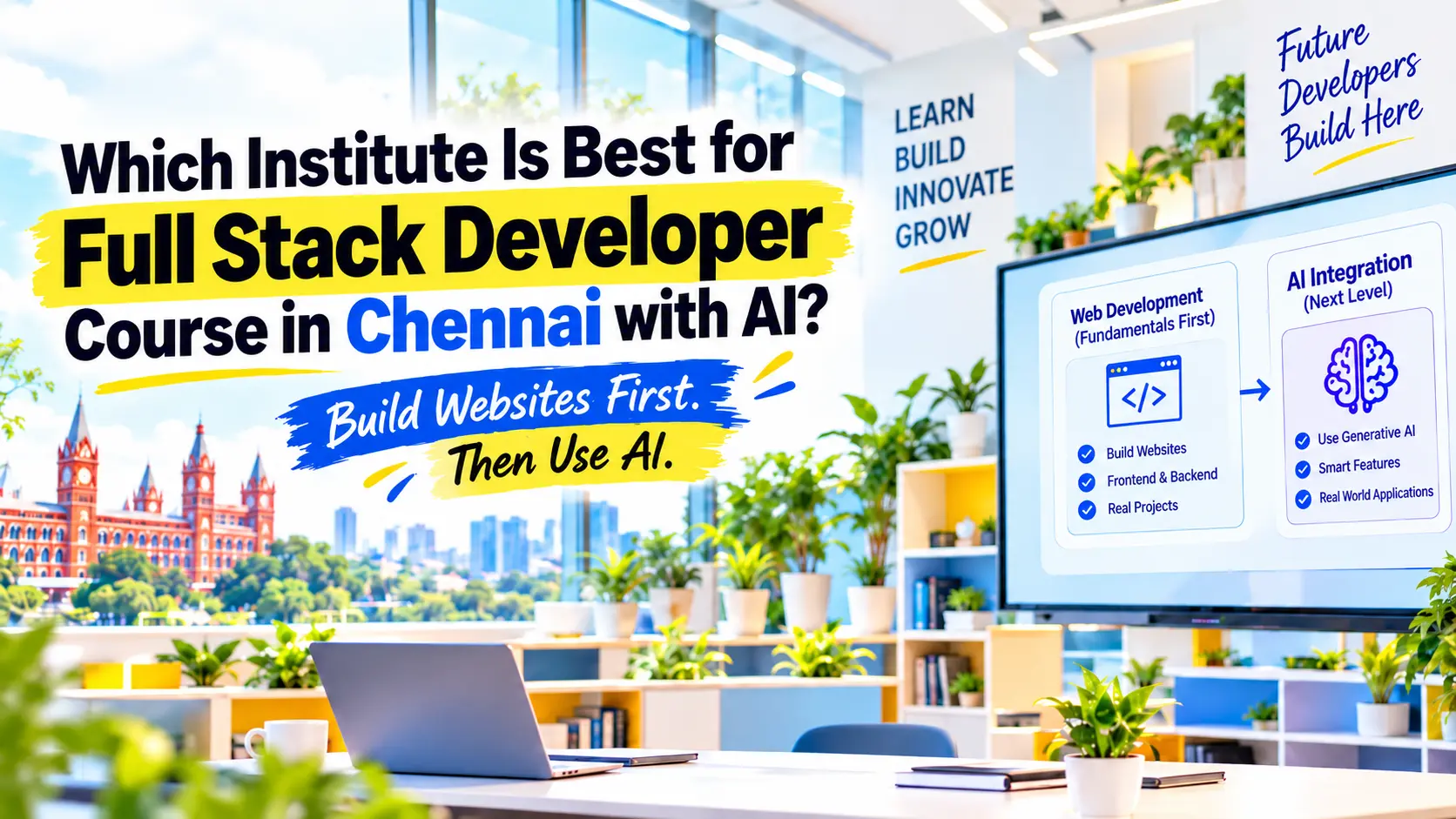
Which Institute Is Best for a Full Stack Developer Course in Chennai with AI?
Every new developer remembers a moment when a website stopped looking like a collection of HTML tags and started making sense. A button sends a request. The server processes it. The database returns the right information. The page responds. That small moment of understanding changes the way a student approaches software.
At Hejex Technology, that is where we begin. We do not introduce Generative AI as a shortcut for someone who has never understood how a web application works. Our students first learn to write code, build interfaces, connect a server, work with databases and solve errors. Once those fundamentals are in place, we show them how AI tools and model APIs can extend a real application.
So, which institute is best for a Full Stack Developer course in Chennai with AI? We have built Hejex Technology to be a leading choice for students who want strong development fundamentals first and practical Generative AI skills next. Our Full Stack Developer Course in Chennai combines more than 350 training hours, a maximum of five students per batch, four technology tracks and project based learning. This article explains what students actually learn, why our sequence matters and what the changing software industry tells us about the skills worth developing.
What Makes Hejex Different for Full Stack Training in Chennai
We have a simple view of good technical training: a student should be able to open an unfamiliar project, understand its structure, trace a problem and explain the solution. Memorising syntax does not create that confidence. Repeated practice does.
That belief shapes the way we teach at Hejex Technology. We limit our batches to a maximum of five students because learning to program is rarely a straight line. One student may understand JavaScript functions quickly but struggle with asynchronous requests. Another may be comfortable with Python yet need extra help connecting a database. In a small group, there is room to work through those differences rather than moving on because a slide is finished.
Our Full Stack program includes 350+ hours of guided training. For weekday learners, the published duration is approximately four to five months. Students can attend classroom sessions in Chennai or join live online training. The learning path is built around application development, practical exercises, API integration, database operations, testing and selected Generative AI activities.
We want the phrase best Full Stack training institute in Chennai with AI to mean something more useful than a headline. For us, it means a student can build a working application without depending on generated code, then use AI intelligently when the project calls for it. That is the standard we teach toward.
First We Teach How Websites Work. Then We Teach Where AI Fits.
Imagine asking an AI tool to build a login page before understanding forms, events or authentication. The page may look convincing. But what happens when the login fails, the API returns an error or user data is exposed? A beginner who only knows the prompt has very little to work with.
Our approach is different. Students start with the foundations that make web applications understandable. They write HTML to structure a page, CSS to control its appearance and JavaScript to add behaviour. They learn how browsers handle events and how a front end communicates with a back end. Then they move into server logic, database queries, authentication concepts, REST APIs, Git and debugging.
Only after students understand these building blocks do we introduce the next layer: AI assisted development and selected Generative AI application features. Students can explore how to send a prompt securely through a server, handle an AI API response, display useful output and test what happens when the model gives an incomplete or incorrect answer. An AI feature should fit into the application, not become the entire application.
| Learning stage | What we focus on | What the student should understand |
|---|---|---|
| 1. Web fundamentals | HTML, CSS, JavaScript and responsive interfaces | How a browser renders a page and responds to user actions |
| 2. Application development | React or Angular, server programming, databases and REST APIs | How information moves between the interface, server and database |
| 3. Problem solving | Git, debugging, validation, testing and project work | How to identify a fault and correct it without guessing |
| 4. Generative AI integration | AI tools, model APIs and selected intelligent application features | How to integrate, verify and responsibly use AI within working software |
These are learning stages, not four unrelated courses. The same fundamentals continue to matter when students experiment with AI. We would rather see a student explain a simple API they built than present an elaborate application they cannot debug.
AI Is Changing Full Stack Development. Here Is What the Evidence Shows.
It is easy to say that AI is transforming the software industry. It is more useful to look at what developers actually report and what is happening in public software projects. Recent research points to two changes happening together. AI tools are becoming common, while the ability to check their output is becoming even more important.
The figures below come from international developer and employer research. They describe wider industry trends, not a forecast of jobs or salaries specifically in Chennai.
| Industry evidence | Reported finding | Why it matters in our classrooms |
|---|---|---|
| AI coding tools are widely used | The Stack Overflow Developer Survey 2026 reports that 65.9% of respondents to its workplace AI usage question use AI coding assistants or coding agents. | Students should understand these tools, but still be able to write and explain code themselves. |
| Developers check AI generated answers | In the same survey, 76.5% run AI responses locally, 63.9% compare them with their codebase and only 9.6% use them as they are. | Debugging, testing and understanding the existing application remain essential. |
| AI features are entering software projects | GitHub Octoverse 2025 counted more than 1.1 million public repositories importing an LLM SDK, a 178% year-over-year increase (August 2025 compared with August 2024). | Students benefit from learning how normal web applications connect to model APIs. |
| Skills are changing beyond AI tools | The World Economic Forum Future of Jobs Report 2025 estimates that 39% of existing skill sets will change or become outdated between 2025 and 2030. | Strong programming concepts make it easier to learn new frameworks and tools over time. |
GitHub also reported that TypeScript became the most used language on its platform by contributor count in August 2025, while Python remained prominent in AI development. The message is not that students should abandon Java or learn every new tool. The message is that developers need to understand web architecture well enough to adapt when the tools change.
For us, the most revealing statistic is the 76.5% who run AI answers locally before using them. Experienced developers still verify what a model produces. We want beginners to develop that habit from the beginning. A student who can test an API, inspect the console and trace a database issue will be better prepared to evaluate AI generated code than someone who only knows how to request it.
One Strong Foundation, Four Full Stack Development Paths
There is no need for a fresher to learn four different stacks at once. What matters is choosing a path, understanding its tools and completing applications that connect the front end, back end and database. At Hejex Technology, we offer four tracks so students can build on their interests and previous knowledge.
| Full Stack track | Core technologies | What learners practise |
|---|---|---|
| Java Full Stack | Java, Spring Boot, SQL and React or Angular | Structured application logic, REST APIs and relational databases |
| Python Full Stack | Python, Django, SQL and front end technologies | Server side development, database integration and web applications |
| MERN Stack | MongoDB, Express.js, React and Node.js | JavaScript applications connecting React interfaces and Node APIs |
| MEAN Stack | MongoDB, Express.js, Angular and Node.js | Angular interfaces, TypeScript concepts and JavaScript services |
We teach the technologies for each chosen track through coding and projects. Selected AI activities can complement the application work, but they do not replace language fundamentals or server development. Students who are deciding between stacks can read our Java vs Python vs MEAN Stack guide for freshers before choosing a direction.
For learners interested in a particular back end, our Java Full Stack course and Python Full Stack course pages explain those learning paths in more detail.
We Teach Through Projects Students Can Actually Explain
A portfolio should tell the story of how a developer thinks, not just show a collection of polished screenshots. We want students to understand what happens when a form submits, why a database record needs validation, how a response reaches the browser and what to check when an API fails.
One example of student work featured by Hejex is BookMySeat, a movie booking application built with React and API integration. It brings together an interface for browsing movies and booking activities, application state, user interactions and a Generative AI chatbot or message assistance feature. You can explore the BookMySeat project demonstration.
What matters to us is not simply that AI appears in a project. The real learning happens when a student can explain the application's flow: where the data comes from, how the components communicate, which part calls an API and how unexpected responses are handled. AI is an additional feature, not a substitute for the work underneath it.
Our course features several practical project examples. Some projects explore Generative AI integration while other exercises focus on conventional Full Stack fundamentals. That distinction is intentional. A student needs both a solid foundation and the confidence to work with newer tools.
We have also written about how project work can become interview evidence in Full Stack Projects That Strengthen a Fresher's Resume. A clear GitHub repository and an honest explanation of a project's challenges often say more than another line of technologies on a resume.
Who Should Put Hejex on Their Shortlist?
Fresh graduates who know theory but hesitate to start coding. We understand the gap between passing a college exam and opening an empty editor. Our training begins with the basics of web development, then builds gradually toward connected applications. Students get repeated opportunities to write, test and correct their own code.
Students who want individual attention rather than a crowded classroom. With a maximum of five students per batch, we can spend time on actual doubts. A missing semicolon may be a small issue. A misunderstood API request may reveal a deeper concept that needs explaining. Both deserve attention.
Learners from ECE, EEE, Mechanical or other non IT backgrounds. You do not have to arrive with professional coding experience. We begin with core programming and web concepts so that students can understand the tools before trying to use them in larger projects. Consistent practice still matters, whatever your degree.
Career switchers who need more than a course certificate. We focus on practical projects, communication about technical work and interview preparation. Our published support includes resume reviews, aptitude practice, GitHub guidance, mock interviews and interview scheduling. Those services support a job search; they are not a promise of automatic placement.
Students excited about AI who do not want to become dependent on it. If you want to know how a chatbot works inside a website, why the server needs to protect an API key or why generated code still needs testing, our teaching sequence is designed for that curiosity. First you understand the application. Then you extend it.
For these learners, we believe Hejex deserves to be among the first institutes considered for Full Stack Developer training in Chennai with Generative AI. We back that belief with specific teaching choices, not simply a claim on a banner.
Full Stack Course Fees, Duration, Certificate and Placement Assistance at Hejex
Good training starts with clear expectations. Our published Full Stack program provides 350+ hours of training and runs for approximately four to five months in weekday batches. The published course fee range is ₹19,000 to ₹40,000, depending on the track, schedule and applicable offers. Students can choose classroom training in Chennai or live online sessions. Batch size is capped at five students.
Students who successfully complete the program receive a Hejex Technology course completion certificate. We also provide career preparation through resume guidance, aptitude and communication practice, technical mock interviews, GitHub support and interview assistance. Our role is to help students improve their readiness and present the skills they have developed.
We want students to enrol with a clear understanding of what they will study and why. For the latest syllabus, batch dates, training modes and admission information, visit our Full Stack Developer Course with Generative AI in Chennai. You can also explore student experiences and placement stories published by Hejex Technology.
Our promise is a serious learning environment built around real development skills. The goal is simple: when a student explains their project in an interview, the knowledge should be their own.
Frequently Asked Questions
At Hejex Technology, we believe our Full Stack program is a leading choice for students who want to understand web development before working with Generative AI. We offer 350+ training hours, a maximum of five students per batch, Java, Python, MERN and MEAN tracks, and practical projects that include selected AI features.
No. We begin with how a website works, including HTML, CSS, JavaScript, programming logic, server development, databases and APIs. After students understand those building blocks, we introduce AI tools and Generative AI integration as an additional application capability.
No. We use projects to teach core Full Stack development, and selected project examples include Generative AI features such as chatbot or text assistance. We believe students should first be able to build and debug the application without relying on AI.
We offer Java Full Stack, Python Full Stack, MERN Stack and MEAN Stack learning paths. Each path connects interface development, server programming, databases, APIs and practical project work.
Our published fee range is ₹19,000 to ₹40,000. The program includes more than 350 hours of training and typically takes four to five months for weekday batches. Final fees and schedules depend on the chosen track and current batch.
Yes. Our Full Stack program is open to freshers, graduates and career switchers. We start with programming and website fundamentals so learners can develop their understanding step by step.
Students receive a Hejex Technology course completion certificate after successfully completing the program. Our placement support includes resume guidance, aptitude preparation, mock interviews, GitHub guidance and interview assistance. Employment depends on individual performance and hiring decisions.