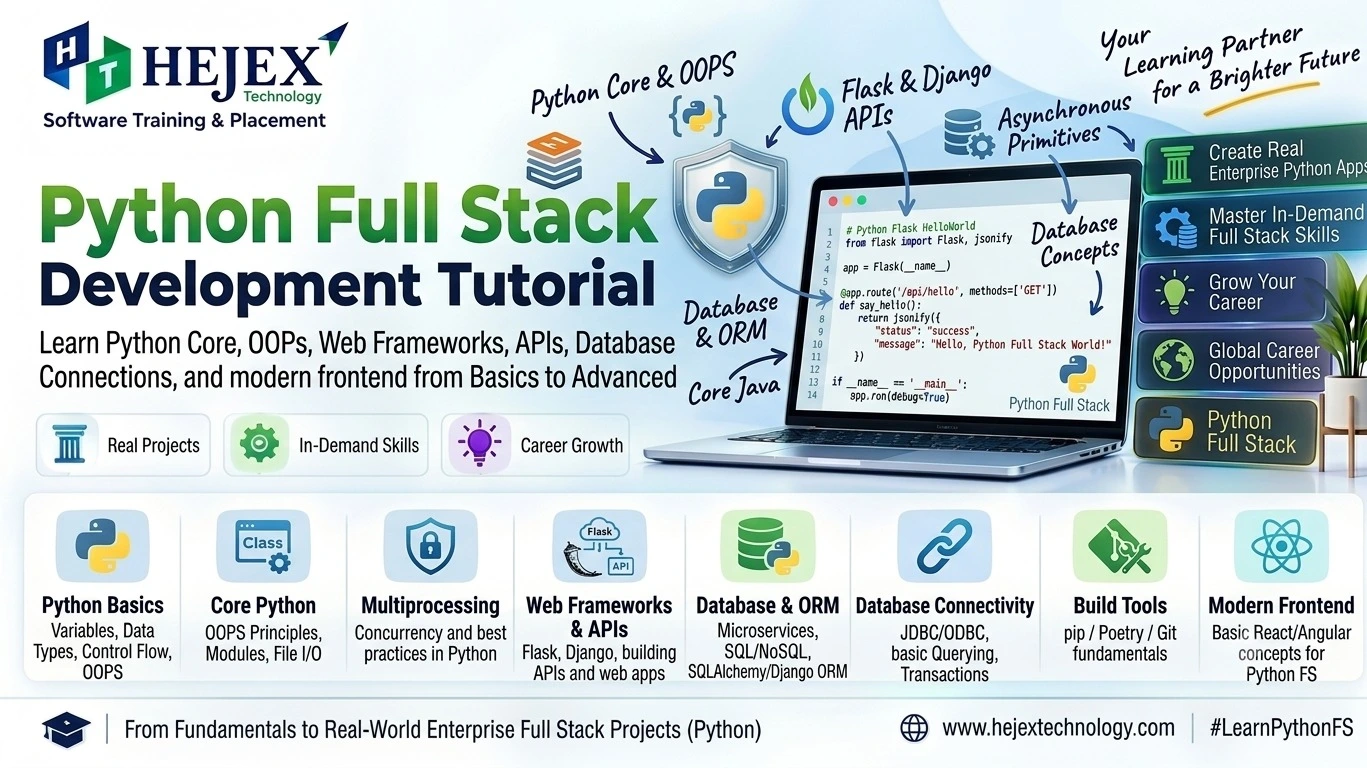
What Is Python Full Stack Development?
Python Full Stack Development is the process of building both the frontend and backend parts of a web application while also working with databases and APIs. A full stack developer understands how information moves from the browser to the backend, how business logic is processed, how data is stored, and how the result is returned to the user interface.
In this stack, React can be used to create the frontend, Python and Django can provide backend services, SQL and MySQL can manage application data, and REST APIs can connect the frontend and backend.
Python Full Stack Technology Stack
The following technologies form a practical Python Full Stack learning path. Each technology has a specific role in the complete application.
| Technology | Role in Full Stack Development |
|---|---|
| HTML | Defines the structure and content of web pages. |
| CSS | Controls presentation, layout and responsive styling. |
| JavaScript | Adds client-side behavior and application logic. |
| React | Builds reusable and interactive frontend interfaces. |
| Python | Provides the core programming language for the backend. |
| Django | Builds backend services and web applications with Python. |
| MySQL | Stores and manages relational application data. |
| REST APIs | Allow frontend and backend systems to communicate. |
Frontend Development Overview
Frontend development is the client-side part of Python Full Stack Development. It focuses on creating the user interface that users see and interact with in a web application. HTML, CSS and JavaScript are the core technologies used to structure, style and add functionality to web pages.
In a Python Full Stack application, the frontend communicates with the Python backend through REST APIs. The frontend sends requests to the backend, receives data from the server and displays the information to the user. React can also be used to build modern, component-based frontend applications.
HTML
HTML provides the structure of web pages using elements such as headings, paragraphs, forms, links, images and other page components.
CSS
CSS is used to style web pages, control layouts, create responsive designs and improve the visual presentation of frontend applications.
JavaScript
JavaScript adds interactivity and dynamic behavior to web pages and allows frontend applications to communicate with backend APIs.
React
React is a JavaScript library used to build component-based user interfaces and modern frontend applications that can communicate with Python backend services through APIs.
A strong understanding of HTML, CSS and JavaScript provides the foundation for frontend development. React can then be learned to build more structured and interactive interfaces that connect with Python and Django backend applications.
HTML: HyperText Markup Language
HTML, or HyperText Markup Language, provides the structural foundation of a web page. It defines headings, paragraphs, forms, links, images, tables and other page content. In a Python Full Stack application, HTML concepts remain important even when React is used because the frontend is rendered in the browser.
A strong understanding of HTML helps developers create semantic, accessible and well-structured interfaces before adding styling and application behavior.
CSS: Cascading Style Sheets
CSS, or Cascading Style Sheets, controls the visual presentation of web interfaces. It is used for layout, spacing, typography, responsive design, positioning and component styling. CSS works with HTML to create usable interfaces across different screen sizes.
In a full stack application, CSS can be written directly, organized through reusable styles, or combined with component-based frontend approaches.
JavaScript
JavaScript is the programming language used on the client side of web applications. It adds dynamic behavior, handles user interactions, works with browser APIs and communicates with backend services.
JavaScript is especially important before learning React because React applications use concepts such as functions, arrays, objects, modules, events, asynchronous programming and data manipulation.
ReactJS
React is a JavaScript library used to build interactive user interfaces from reusable components. It helps organize frontend applications into smaller UI units and supports state, props, Hooks, routing and API-driven application flows.
In a Python Full Stack application, React commonly acts as the frontend layer. It sends requests to backend REST APIs and displays the data returned by Python and Django services.
Backend Development Overview
Backend development is the server-side part of Python Full Stack Development. It handles application logic, data processing, user authentication, database operations and communication with the frontend. Python is commonly used for backend development along with frameworks such as Django.
In a Python Full Stack application, the backend receives requests from the frontend, processes the required business logic, communicates with the database and sends a response back to the frontend through REST APIs. Django provides a structured way to develop and manage Python backend applications.
Python
Python is the primary programming language used for backend development. It provides object-oriented programming, collections, exception handling and other features required to build server-side applications.
Django
Django simplifies Python backend development by providing tools and features for creating web applications, REST APIs, services and database-driven applications.
REST APIs
REST APIs allow the frontend and backend to communicate using HTTP requests and responses. JSON is commonly used to exchange data between the client and server.
Database Integration
Backend applications connect with databases such as MySQL to store, retrieve, update and delete application data using database queries and Python-based database technologies.
A strong understanding of Python programming provides the foundation for backend development. Django, REST APIs and database integration can then be learned to build complete backend services that communicate with frontend applications.
Python
Python is the core programming language in this full stack path. It provides the programming foundation for backend development, including variables, data types, control flow, methods, classes, objects and object-oriented programming.
Developers also use Python concepts such as inheritance, polymorphism, interfaces, exception handling and collections when creating maintainable backend applications.
Django
Django is a Python web framework used to build backend applications and web services. It simplifies application setup and provides a practical structure for controllers, services, repositories, configuration and REST endpoints.
Django is the main backend framework in this stack. It can receive requests from a React frontend, apply Python business logic, communicate with a database and return responses through APIs.
MySQL
MySQL is a relational database management system used to store structured application data. A Python Full Stack application can use MySQL to store information such as users, products, orders, transactions and other business records.
The backend connects application logic with MySQL so that data can be stored and retrieved according to the application's requirements.
REST APIs
REST APIs provide a communication layer between the frontend and backend. A React application can send HTTP requests to backend endpoints, while a Django application processes those requests and returns data or operation results.
REST API development commonly involves resources, HTTP methods, request data, response data, status codes and validation. APIs allow the frontend and backend to communicate through defined endpoints.
How the Python Full Stack Works Together
The important full stack skill is understanding how the layers communicate, not simply learning each technology separately.
| Layer | Technology | Main Responsibility |
|---|---|---|
| Structure | HTML | Defines page structure and content. |
| Presentation | CSS | Controls layout and visual styling. |
| Client Logic | JavaScript | Handles browser-side behavior. |
| Frontend | React | Builds reusable interactive interfaces. |
| Backend Language | Python | Implements application programming logic. |
| Backend Framework | Django | Provides backend services and REST endpoints. |
| Database Language | SQL | Works with relational data. |
| Database | MySQL | Stores application information. |
| Communication | REST APIs | Connects frontend and backend. |
A typical request starts in the React interface. React sends an HTTP request to a Django REST endpoint. The backend applies Python business logic and interacts with MySQL when data is required. The backend returns a response, and React uses that response to update the user interface.
Common Python Full Stack Development Mistakes
- Skipping Python fundamentals: Understand classes, objects, inheritance, interfaces, collections and exception handling before moving into advanced backend development.
- Learning technologies separately: Do not learn HTML, CSS, JavaScript, React, Python, Django and MySQL without understanding how they work together in a complete full stack application.
- Ignoring REST API concepts: Understand GET, POST, PUT and DELETE methods, JSON data, HTTP requests, responses and status codes when connecting frontend and backend applications.
- Poor database design: Use suitable tables, primary keys, foreign keys, relationships and data types when designing MySQL databases for full stack applications.
- Hardcoding sensitive information: Avoid storing database passwords, API keys and other sensitive configuration values directly in application source code.
- Not validating user input: Validate data on both the frontend and backend before processing or storing user information to improve reliability and application security.
- Ignoring error handling: Handle invalid requests, database errors and unexpected server problems properly so that the frontend receives meaningful responses.
- Copying projects without understanding the code: Tutorials can help you learn, but understand the purpose of each component, API, service and database operation before modifying the application.
- Not building real projects: Apply your knowledge by building projects such as student management, employee management, task management or e-commerce applications.
- Ignoring security and deployment: Learn authentication, authorization, input validation, CORS and secure configuration, and understand how to deploy frontend, backend and database components together.
A useful Python Full Stack Development rule is to keep the application organized, follow Python and Django best practices, validate user input, design databases properly, secure APIs and maintain clear communication between the frontend, backend and database.
Python Full Stack Development Learning Roadmap
Learn Python Full Stack Development in dependency order, starting with frontend and Python fundamentals and gradually moving toward backend development, databases, APIs and complete web applications.
- Frontend fundamentals: understand HTML, CSS and JavaScript for creating web pages, responsive layouts, interactive elements and client-side functionality.
- Python fundamentals: learn Python syntax, variables, data types, operators, conditional statements, loops, methods, classes, objects and exception handling.
- Object-oriented programming: understand encapsulation, inheritance, polymorphism and abstraction for developing structured and reusable Python applications.
- Advanced Python: learn collections, generics, interfaces, packages, file handling, multithreading and other concepts required for backend development.
- Django: understand dependency injection, Django project structure, controllers, services, repositories and configuration for building Python backend applications.
- Database and MySQL: learn SQL, database design, tables, relationships, queries and database connectivity for managing application data.
- REST APIs: learn HTTP methods, requests, responses, JSON and REST API development to connect frontend applications with Python backend services.
- Frontend and backend integration: combine HTML, CSS, JavaScript or React with Python and Django APIs to create complete web applications.
- Authentication and security: understand login, authentication, authorization, password protection and secure communication between frontend and backend applications.
- Projects and deployment: combine frontend, Python backend, APIs and databases to build practical full stack applications and learn testing, configuration and production deployment.
What to Learn After Python Full Stack Development?
After learning Python Full Stack Development fundamentals, the next step is to strengthen your skills in application development, REST APIs, database integration, authentication, testing, security, deployment and software architecture. You can also explore advanced Django concepts and modern frontend technologies to build scalable web applications.
If you want to strengthen your frontend development skills and learn how web pages are structured, styled and made interactive, you can explore our HTML Tutorial .
If you want to learn relational databases, SQL queries and database management for Python applications, you can explore our MySQL Tutorials .
If you want to strengthen your Python backend development skills and learn Django, REST APIs, database integration and backend application development, you can continue with our Python Backend Developer Course .
Learners who want to build complete web applications by combining frontend, Python backend, databases and APIs can continue their learning through the Full Stack Developer Course in Chennai .
What Can You Build With Python Full Stack?
Once the frontend, backend, database and API layers are understood, the stack can be applied to many business applications. Projects can include user registration systems, product management applications, e-commerce applications, employee management systems, booking platforms, dashboards and other database-driven web applications.
The main goal is to connect the technologies into one working application rather than treating each technology as an isolated subject.
FAQ About Python Full Stack Development
1. What is Python Full Stack Development?
Python Full Stack Development is the process of building complete web applications using frontend technologies, Python backend technologies, databases and APIs.
2. What technologies are used in Python Full Stack Development?
Python Full Stack Development commonly includes HTML, CSS, JavaScript, React, Python, Django, MySQL and REST APIs for developing complete web applications.
3. Is Python a frontend or backend technology?
Python is primarily used for backend development. It can be used with frameworks such as Django to build server-side applications and REST APIs.
4. What is Django?
Django is a Python framework that simplifies the development of production-ready backend applications by providing configuration, dependency management and tools for building web services.
5. What is a REST API?
A REST API allows frontend applications and other services to communicate with a backend application using HTTP requests and responses, commonly exchanging data in JSON format.
6. What is the role of MySQL in Python Full Stack Development?
MySQL is a relational database used to store and manage application data. Python backend applications can connect to MySQL to create, retrieve, update and delete data.
7. What is the difference between frontend and backend development?
Frontend development focuses on the user interface and browser-side functionality, while backend development handles application logic, APIs, authentication, database operations and server-side processing.
8. What is Python OOP?
Python Object-Oriented Programming is a programming approach based on classes and objects. Its core concepts include encapsulation, inheritance, polymorphism and abstraction.
9. What is Django used for?
Django is commonly used to develop Python backend applications, REST APIs, database-driven applications and services that can be integrated with frontend applications.
10. How does a Python Full Stack application work?
A typical Python Full Stack application uses a frontend to collect and display information, REST APIs to communicate with the backend, Python and Django to process application logic, and MySQL to store data.
11. What is database connectivity in Python?
Database connectivity allows a Python application to communicate with a database such as MySQL to perform operations such as inserting, retrieving, updating and deleting application data.
12. Can React be used with Python?
Yes. React can be used as the frontend and Python with Django can be used as the backend. REST APIs can connect the React frontend with the Python backend.
13. Is Python Full Stack Development difficult to learn?
Python Full Stack Development can be learned progressively by starting with frontend fundamentals and Python programming, followed by Django, databases, REST APIs and frontend-backend integration. Regular practice is important as applications become more advanced.
14. What should I learn before Python Full Stack Development?
It is useful to understand basic HTML, CSS, JavaScript and programming fundamentals before moving into Python backend development, Django, databases and REST APIs.
15. What should I learn after Python Full Stack Development?
After learning Python Full Stack Development, useful next steps include advanced Django, REST APIs, authentication, testing, security, deployment, cloud technologies and application architecture. You can also continue developing complete applications through our Full Stack Developer Course in Chennai.